Struggling to follow conversations in noisy places? Here's why speech can become harder to understand, and what a hearing assessment can reveal.

It's easy to assume your hearing must be fine because you can still hear plenty of sounds. But hearing a voice and understanding the words are not quite the same thing.
Perhaps you're fine talking to one person at home, but lose parts of the conversation in a restaurant. You might find yourself asking people to repeat themselves, or thinking that everyone seems to mumble these days.
If conversations aren't as clear as they used to be, the important question isn't simply "Can I hear?" It's "What am I actually hearing, and why am I missing parts of speech?"
Hearing a voice and understanding the words are different
Speech contains lots of different sounds. Some give speech much of its volume, while others provide the finer detail that helps us distinguish one word from another.
If your hearing changes at particular frequencies, you may continue to hear the overall sound of somebody's voice while some of those finer details become less distinct.
A useful way to think about it is like reading a sentence with a few letters rubbed out. You can still see the words on the page — but as more letters disappear, understanding takes more effort.
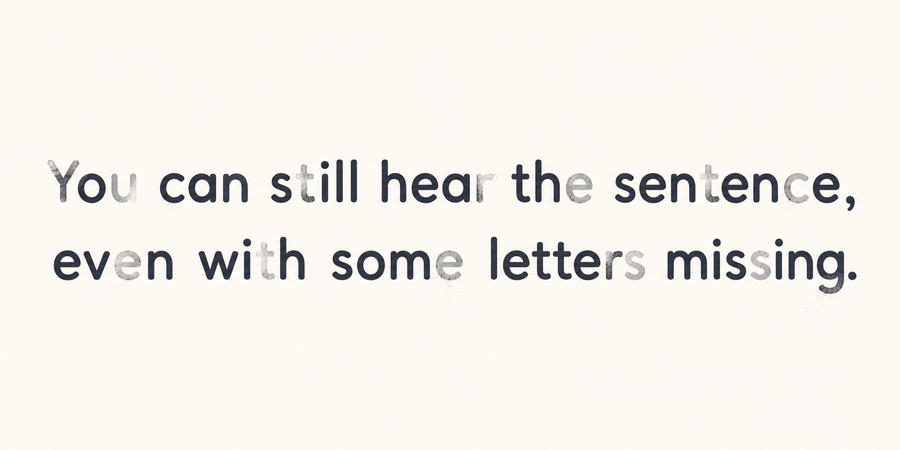
Something similar can happen with speech. You hear the person talking, but your brain has to work harder to fill in the pieces you haven't heard clearly. That can explain why simply asking someone to speak louder doesn't always solve the problem.
Why restaurants and social gatherings are so difficult
A busy restaurant is a much more demanding listening environment than your living room. The person opposite you is speaking, but around them are other conversations, music, cutlery, chairs moving and noise from the kitchen.
Your hearing system has to separate the voice you want to listen to from everything else happening around you. If some of the detail within speech is already less clear, background noise makes it much harder for your brain to fill in the missing pieces.
You may still hear the person's voice perfectly well. You just can't reliably make out the words — which is why people often first notice a change in their hearing in restaurants, family gatherings, meetings and other situations where several sounds compete for their attention.
It can also explain another common experience: listening becomes tiring. Instead of conversation happening naturally, you find yourself concentrating on it.
Changes like this can happen gradually enough that you adapt without really noticing — watching people's faces more closely, working out a missed word from context, turning the television up, or choosing a particular seat at the table. In quiet surroundings, these strategies can work remarkably well. It's when you're somewhere noisy that keeping up suddenly gets much harder.
"But I can hear a pin drop"
You might hear the birds outside, a clock ticking or a quiet noise elsewhere in the house, and quite reasonably think: there can't be much wrong with my hearing.
But hearing isn't simply a volume control that works equally across every type of sound. Your ability to hear can vary at different frequencies, and detecting a quiet sound in a quiet room is a different listening task from understanding a conversation when several other people are talking.
That is why somebody can be very aware of certain quiet sounds while still finding speech increasingly difficult to understand.
What can a hearing test tell us?
A conventional hearing test usually includes pure-tone audiometry. This measures the quietest sounds you can hear at different frequencies and provides important information about your hearing.
But an audiogram doesn't necessarily tell us everything about how easily you communicate in everyday life. NICE guidance specifically recognises that people can have listening difficulties, including difficulty hearing in noisy environments, that may not be obvious from the audiogram.
That is why a good hearing assessment should involve more than looking at a graph. We also want to understand how your hearing is affecting you:
- Are you fine one-to-one but struggling in groups?
- Does television dialogue seem less clear?
- Do you hear a voice but miss particular words?
- Are some people much easier to understand than others?
- Do you avoid certain seats in restaurants because you know you won't hear well?
- Are conversations requiring more concentration than they used to?
Those details can be extremely useful when we assess your hearing. If your main difficulty is background noise specifically, it's worth investigating that directly. Speech-in-noise testing assesses how well you can understand speech when there is competing sound in the background — a listening situation much closer to the one that may actually be causing you problems, rather than simply asking whether you can detect a quiet beep. It doesn't replace the conventional hearing test; it gives us another useful piece of information about how you manage in everyday listening situations.
Understanding speech involves more than your ears
Your ears detect sound, but your auditory system also has to make sense of what you hear and separate the voice you want to listen to from competing sounds. There are several reasons why speech can become harder to understand, so it is better to assess the problem properly than to assume what is causing it.
Does this mean I need hearing aids?
Not necessarily. Having your hearing assessed should not begin with the assumption that you need hearing aids. It begins by finding out what is happening.
If we identify a change in your hearing, we'll explain what we've found and discuss whether doing anything about it would be worthwhile for you. Depending on your hearing and your individual circumstances, that might mean advice, monitoring, communication strategies, hearing technology or, where appropriate, further investigation.
And if hearing aids would be helpful, the discussion should be about much more than making sounds louder. The important question is whether appropriately selected, fitted and personalised technology could make the listening situations you care about easier.
If your hearing has changed suddenly — particularly over three days or less — this is different from a gradual change in speech clarity, and you should seek prompt medical advice. Sudden hearing loss can require urgent specialist assessment.
What is happening with your hearing?
At Buchanan Optometrists and Audiologists, we take time to understand not only what you can hear, but where you are finding hearing difficult in everyday life.
The purpose of the appointment is to understand your hearing properly before discussing what, if anything, you should do about it. We allow 1–1.5 hours so there is time for appropriate testing, including speech-in-noise testing, as well as a proper discussion of the situations you are finding difficult. We will explain what we find and talk you through the sensible next steps for you.
When is it worth having your hearing assessed?
You don't have to wait until your hearing feels "bad." RNID's guide to the common signs of hearing loss includes many of the everyday experiences we hear about most. It may be worth having your hearing assessed if:
- People increasingly seem to mumble
- You hear voices but miss parts of sentences
- Restaurants or group conversations have become harder work
- Television dialogue isn't as clear as it used to be
- You frequently ask people to repeat themselves
- Listening requires more concentration than it used to
None of these automatically means you need hearing aids. They're simply good reasons to find out more.
Frequently asked questions
Why can I hear people talking but not understand the words?+
You may still be hearing the overall sound of speech while some of the finer detail that makes words clear becomes harder to detect — something background noise often makes more noticeable. A hearing assessment is the best way to investigate your individual hearing.
Why can I hear fine at home but not in a restaurant?+
A quiet one-to-one conversation involves relatively little competing sound. In a restaurant, your auditory system has to separate the person you want to hear from numerous other sounds, which is considerably harder if some speech detail is already less clear.
Can I have hearing difficulties even if I can hear quiet sounds?+
Yes. Hearing sensitivity can vary across different frequencies, and understanding complex speech is a different task from detecting a quiet sound. A proper assessment investigates both.
What is a speech-in-noise test, and will I need one?+
It looks at how well you understand speech when other sound is present at the same time. It's carried out as standard for every patient at our hearing assessments, so you don't need to request it separately — particularly useful if your main difficulty happens in restaurants, meetings or other noisy environments.
Will I be told I need hearing aids?+
Not necessarily. Any recommendation is based on your test results, your communication needs, and your individual circumstances — not the other way around.
How much does a hearing assessment cost, and how long does it take?+
£250, and around 1 to 1.5 hours with an HCPC-Registered Audiologist.
Find out why you're hearing people but missing the words
If conversations are becoming harder to follow, you do not need to decide for yourself whether your hearing is "bad enough" or whether you need hearing aids. That is what the assessment is for. We will investigate your hearing, including how you understand speech in background noise, explain what we find and discuss whether any action would be worthwhile.
Book your hearing assessment